These Sculptures are located in Shamian Island and I found them interesting. First sculpture shows a street hawker selling malt candy to 2 children. I used to enjoy the sticky malt candy when I was a child. It is interesting to see the container of the malt candy. Second piece shows a Chinese using a abacus (珠算) sitting with a foreigner. The abacus is an unique calculator used in trade and sale of goods. The last interesting sculpture is the transformation of the modern Chinese lady. The artist seems to feel that the modern lady has shorter pants and a tighter blouse.
Saturday, July 23, 2016
Guangzhou Part 9 - Interesting Bronze Sculpture
These Sculptures are located in Shamian Island and I found them interesting. First sculpture shows a street hawker selling malt candy to 2 children. I used to enjoy the sticky malt candy when I was a child. It is interesting to see the container of the malt candy. Second piece shows a Chinese using a abacus (珠算) sitting with a foreigner. The abacus is an unique calculator used in trade and sale of goods. The last interesting sculpture is the transformation of the modern Chinese lady. The artist seems to feel that the modern lady has shorter pants and a tighter blouse.
Wednesday, July 20, 2016
Guangzhou Part 8 - Shamian Island
Shamian (沙面) Island - It is an island because of a 30m width canal that separates the main land and this parcel of land. The island is connected via bridges.
The island is unique as it was considered prime land given to the British and French under concession during the 19th and early 20th century (under Qing dynasty). A great dishonor to the Chinese as the island was of strategic importance during the Opium wars with the foreigners. A reflection of the weak Qing dynasty, which was subsequently over thrown by Mr Sun Yat-Sen. The historical lessons had thus taught many Chinese of the need to protect herself against foreign intervention and bullying, which could be seen from current China strategic positioning in foreign affairs and policies involving territorial disputes. Since the Opium wars, what a reversal of fortune for the British and French. Vice versa for the Chinese.
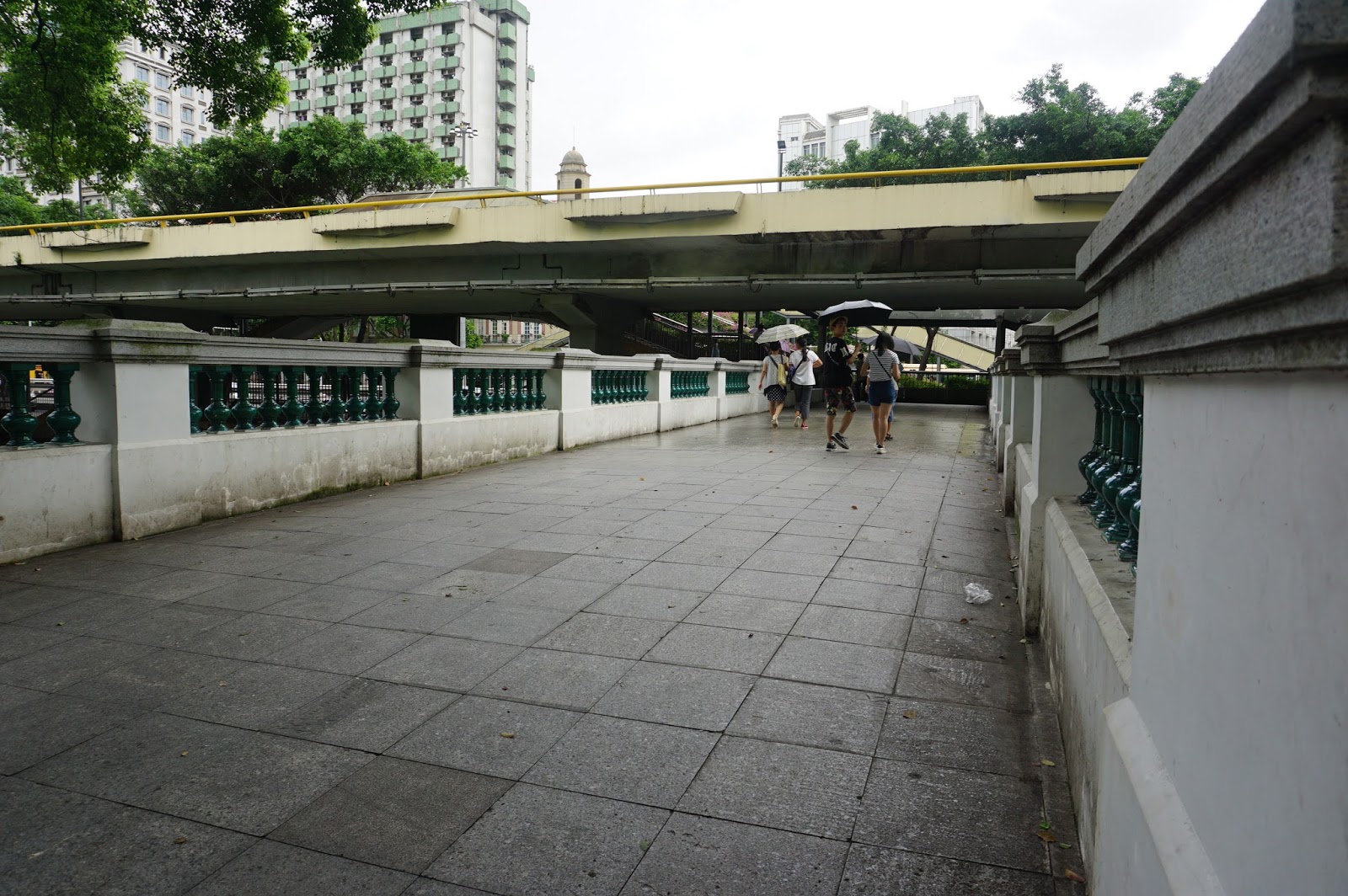
There are many historical bridges and buildings in Shamian Island. The most interesting is the British bridge built in 1861. The buildings are also of architectural significance showing British/French design dated back to 19/20th century. They were well preserved and treated as Gazette buildings when the rest of the cities redeveloped. There are also many old trees along the canal. Now, we can see the local residents dancing and practicing Taichi in several locations around the island. Shamian island can be reached by using the Guangzhou subway train line 1 or line 6 and alight at 黄沙站 (huang sha station). Get out of the station from Exit F and walk about 10 minutes south to the island.
| The former British Bridge built in 1861. The overhead structure is now an expressway. |
| Shamian Island on the left |
Sunday, July 17, 2016
Guangzhou Part 7 - Chinese Game 陆战棋
| 陆战棋 |
| Terrain Map of the Game |
When I was a Primary School student, I was good at this game (literally means Army Game) . Each piece can represent a Captain, Lieutenant, a hand grenade, a mine, a Commander, a foot soldier etc. Each piece is placed in the printed box on the plastic terrain map provided. Back then the pieces was carved out of wood. Now it is in plastic.
I am so glad that I purchased this game set in a supermart in Guangzhou China for RMB24 (S$5.10). The objective of the game is to secure the State Flag (which is also represented in piece). The games pieces are placed downward so that each player does not know the placement strategy of the soldiers and explosive. A referee will look at the pieces of the red and blue sides to determine who will be the winner in each move. The State Flag is secured by pushing the soldiers forward to overcome the enemy force. For example, a Captain of the blue side will win against a Lieutenant of the red side. However, only humans and hand grenade can move. A mine and State flag will not be able to move. Humans can be killed by hand grenade or a mine, regardless of rank.
There is a strategy to win the game as many young players will simply put their junior soldiers in the frontline. Of course, there is an element of luck too.
I will keep this game in excellent condition as a memory of my childhood.
Saturday, July 16, 2016
Guangzhou Part 6 - Luo / Law / Loh Ancestors Hall 良溪罗氏大宗祠
| Entrance to 罗氏 Great Hall |
| The statue of the Founder - 罗贵 |
| The red poster shows the donations made by various members of 罗氏 |
| 罗氏 Ancestor Place of Worship and Respect. The carving and dragon are lined in gold. |
| The tablets showing 罗氏 descendants from all over the world, including Vietnam, Hong Kong, Malaysia and various Provinces in China |
| The Courtyard of the Hall |
| A pond facing the Hall |
| Entrance to 良溪 village where 罗氏大宗祠 is located |
Photos and information correct as at July 2016. Photos are all rights reserved of this blogger.
More information on the internet:-
Wikipedia:-
Chinese blog:-
Location:
Liang Xi Cun, Jiangmen, Guangdong, China
Wednesday, July 13, 2016
Guangzhou Part 5 - Jade
| Jade Market in Guangzhou |
| Jade B and C grade, Guangzhou Museum |
| Jadeite Rock, Guangzhou Museum |
While in Guangzhou, I was looking for a jade traditional Chinese stamp (印章). I walked around 长寿 西路 and found that the price could be from RMB1500 to RMB 2500 for a stamp with a dragon carving on top. In the end, I found a RMB500 jade Chinese stamp. This was found after walking round the shops in the rain. After purchasing the jade, I had to find a carving master to carve my name on the jade. A shop which I asked quoted RMB400 and needed a few days. I walked away and was fortunately to find one craftsman in the Airport who was willing to carve on the jade for RMB100. Finding the right price and avoiding being exploited are keys to getting the right jade pieces. The trick is to make comparison.
Guangzhou is the centre of jade trade because of the huge demand from the Chinese. These jade were mined in neighbouring Myanmar and were bought over by traders.
Tuesday, July 12, 2016
Guangzhou Part 4 - Cost of Living
While travelling to Xin Hui, the driver had asked me a hypothetical question, "would it better if my ancestor had not travelled to Singapore and we had stayed in China?" My immediate reply was that many Chinese currently are requesting for immigration to overseas, among other countries, Singapore. There must be reason for this. Firstly, it is because of the education system which enable Singaporeans to be taught in both English (the commercial language) and a mother tongue. Secondly, the ability of Singaporeans to travel easily without the need of a Visa, which includes countries in the Euro zone and the US.
It sets me into deeper thought on what would I be if I were to be in China, perhaps a small business man, a farmer, an office worker? Would I enjoy the same convenience and wealth as a Chinese or Singaporean? Of course, my deeper concern is the need to go through the Cultural Revolution in the 1970s, although Guangzhou area would not be so severely affected.
| 羊城晚报 Article |
It also sets me thinking on the cost of living in China, specifically in big city like Guangzhou. I had specifically brought back this article from the local newspaper, 羊城晚报, dated 7 July 2016. In the article, a reader had asked for advice for purchase of property. She shared that she is earning a monthly salary of about 7000 RMB (about S$1400) and she is approaching 30 years old soon. She is asking what value of property can she purchase assuming that she has a saving and parental contribution of about 700,000 RMB (about S$145,800). The newspaper expert advised that the value of property that she can purchase is about 1,100,000 RMB (about S$229,000). A $1.1 million RMB unit is only about 50 to 60 sqm. For bigger area of more than 90 sqm, the cost can be in excess of $2 million RMB (about S$416,000). See photo from a property agent.
From a simple mathematical ratio, a Guangzhou resident needs $1.1million/7000 = 157 months of salary to purchase a property. Comparatively, a Singaporean (single and about same age) needs $300,000/4000 = 75 months. It is less stressful for the Singaporean to purchase a government subsidized public housing of about 90sqm. Both Singapore and China(Guangzhou) has a Central Provident Fund system which allows residents to make use of the fund to partially pay for the purchase of the property.
Secondly, the cost of meal in Guangzhou is between 10 to 20 RMB. While in Singapore, a hawker centre meal will be between S$3 to S$5. Comparatively, it is still cheaper to eat in Singapore.
However, the killer expenditure in Singapore is private transport. The purchase of a car will set the comparative advantage back.
The driver and I subsequently discussed the topic of retirement. For that, I would think China, especially the third or fourth liner cities and suburb would offer much better lifestyle for retirement. The driver shared that he could retire in the suburb of the city of his birth, Si Chuan with a big house and a garden to grow crops of his own desire. He shared that the house has 10 rooms. Whenever, there is an urge to visit the city, he could just drive and purchase things that he needs. I agreed.
Monday, July 11, 2016
Guangzhou Part 3 - Ship with Canvas Sail
| Canton Waterfront painted in 1845, Guangzhou Museum. |
| Replica of a ship with canvas sail (帆船), Guangzhou Museum |
| Contribution from overseas Chinese from Canton, Guangzhou Museum |
My paternal grandmother came from Xin Hui, Canton Province prior to WWII.
She came to seek better fortune and livelihood in South East Asia(南洋) and eventually landed in Singapore.
In Guangzhou Museum, there was a large section that showed the contribution of people from Guang Dong Province(Canton) who travelled world wide for the purpose of work and supporting families back home. In display was this large replica of a ship with canvas sail (帆船). It is the basic mode of transport prior to the war. Probably, it took a month to sail from Canton to South East Asia. In present day, an airplane will take 4 hours. My grandmother had taken the canvas sail ship to travel.
Sunday, July 10, 2016
Guangzhou Part 2 - Food in the City
While in city of Guangzhou, I tried the egg tarts. There are many shops selling egg tarts. I especially like this shop that bakes its own tarts and other pastries. It is located at 文昌北 road. The name of the shop is called 'Sisters Bakery' (姐妹 烘焙). The nearest train station is chang shou road station. It is so nice that I went back to the shop twice. The price of the tarts was 5 RMB for 4 nos.
The difference between egg tarts in Guangzhou and in Singapore is that in Singapore, the tarts have a thick pastry base. While the tarts in Guangzhou are baked with thin crust that are almost in layers. The egg content is soft and tasty. Most of the time, the tarts are baked within the day of sale, hence freshness is guaranteed. I wished we could have this egg tarts at that price in Singapore.
| Sisters Bakery |
| Egg Tarts |
![]() |
| Sisters Bakery |
Other than tarts and pastry, locals Cantonese like to eat porridge and 肠粉. In Guangzhou, the 肠粉 is thicker and there are ingredients such as pork and vegetable in it. A thicker layer satisfies the hunger but much effort is needed to chew. In shop serving 肠粉 to locals, the price of the dish can be as low as 6 RMB (S$1.25) which is a cheap breakfast and provides a filling food. The sauce is good too.
![]() |
| 肠粉 |
I also noticed that in Guangzhou, when a person ordered traditional wan ton noodle (传统云吞面),it is actually soup based. In Singapore, 云吞面 is usually not soup base, unless otherwise specified. See below. The shop is located very close to Sun Yat Sun Memorial Hall and the price of the noodle is 13RMB.
![]() |
| 传统云吞面 |
Saturday, July 9, 2016
Guangzhou Part 1 - Food in Xin Hui
I was in Guangzhou China from 3 to 8 July 2016.
In the few days in Guangzhou city, I felt that the food culture was diluted by the infiltration of food from other cities. In a big city with short time, it was difficult to find authentic good food. Most of the time, there were food from Si Chuan and spicy food from the North.
When I travelled out of the city to Xin Hui (新会), I was most fortunate to find this local restaurant located at the junction of 田心 road and 骑虎西 road, where I had a good Cantonese claypot rice. The restaurant is named 曼特宁. I ordered the pork ribs claypot rice for 20 RMB (S$4.20) and it comes with a soup and a vegetable dish. In China, it is common to find food spiced with monosodium glutamate (MSG) to make the food tasty. However, I will feel extremely thirsty after consuming MSG. In this claypot, however, it was tasty enough without the use of MSG. There was Chinese black bean commonly used in Cantonese cooking. Also special was the soup which was prepared with octopus and corn. The claypot rice was worth every penny which I paid for.
Xin Hui is a city in Jiang Men (江门)Guangdong (Canton) Province. It is about 1.5 hours drive from Guangzhou city.
| Whole set for RMB20 |
| A Tasty and Good Pork Ribs Claypot Rice at Xin Hui, China |
| 曼 特宁 Restaurant |
| Location of the Restaurant. From Baidu Map |
Wednesday, June 15, 2016
Audi Q5 Quattro
![]() |
| Audi Q5 2.0 |
As compared to A3 which I own, A6 which I had driven, the Q5 has a different feel.
Cons of Q5
* The brake is weak as compared to A3. It takes a lot of leg effort to stop this car.
* High fuel consumption. Estimate it to be 10 km/litre for expressway and much less for city travel. A few probable reasons, firstly it is a 2 litre car, then it is heavy and lastly it is 4 wheel drive.
* The A3 feels more agile and highly maneuverable. The Q5 is very much bigger in size and driving it requires more attention. I do like the big side mirror.
![]() |
| Interior of Q5 |
* The suspension is better as compared to A3 but not as good as A6, especially Avant. A3 tends to vibrate more as it is lighter in weight comparing it to Q5.
* The sitting position is such that getting in and out is easy. The ride height is very convenient especially for older folks.
* The power steering works well even though this is a heavy car. Turning is light.
* It is spacious both at the front and rear seats.
Subscribe to:
Posts (Atom)